


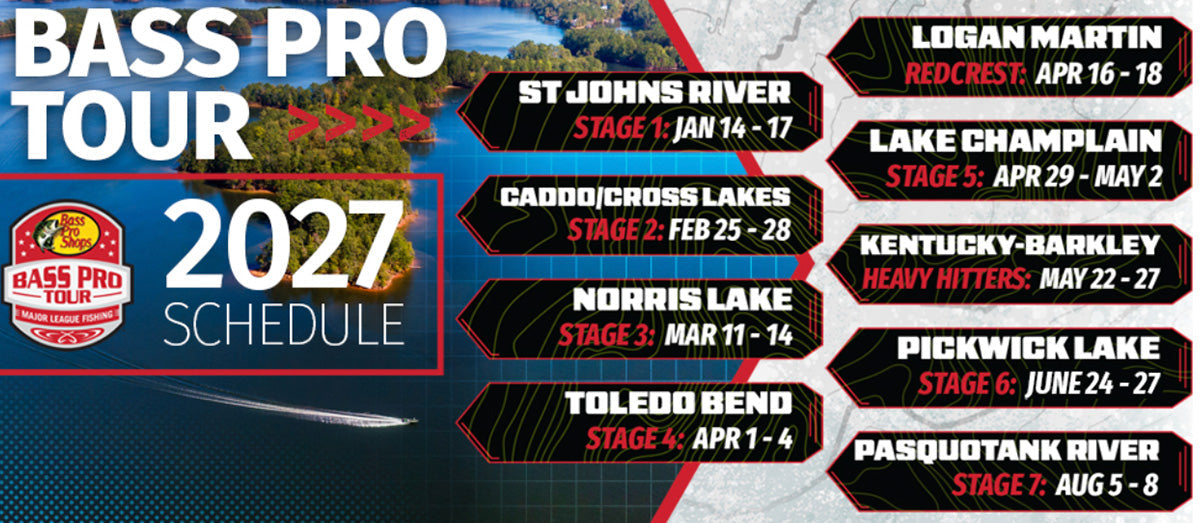
The 2027 Major League Fishing Bass Pro Tour schedule has officially been released, and on paper, it may be one of the most balanced lineups we've seen in years. The season features everything from Florida spawning largemouth and Louisiana cypress trees to deep Tennessee reservoirs, northern smallmouth, and a tidal river finale. More importantly, it appears to strike a better balance between traditional shallow-water fishing and the growing influence of forward-facing sonar.

Unlike previous seasons where electronics seemed to dominate several events, the 2027 schedule presents multiple opportunities for anglers to win with power fishing, shallow-water instincts, and old-school decision making. While forward-facing sonar will undoubtedly play a role, it won't be the deciding factor everywhere.
Here's our early breakdown of every stop on the 2027 Bass Pro Tour schedule.
Stage One – St. Johns River
January 14-17
The season opens in Florida, where January can either produce incredible catches or humble even the best anglers depending on the weather.
Stable temperatures could lead to massive spawning and prespawn bags, while a single cold front could completely reset the fishery overnight.
What to Expect
- Spawning largemouth
- Pads and vegetation
- Boat docks
- Offshore shell bars if conditions stabilize
Forward-Facing Sonar Impact
Low
Florida has never been a forward-facing sonar dominated fishery. Most winning fish are caught around visible cover or spawning areas, making traditional shallow-water techniques the likely path to victory.
Stage Two – Caddo/Cross Lakes
February 25-28
Perhaps the most intriguing stop on the schedule.
Caddo and Cross Lakes offer completely different personalities, but both reward anglers willing to fish shallow cover.
Expect competitors to spend their time around:
- Cypress trees
- Grass
- Backwater drains
- Boat docks
This event should bring power fishing back into the spotlight.
Forward-Facing Sonar Impact
Very Low
The stained water, shallow vegetation, and abundance of targets naturally reduce the effectiveness of electronics.
Spinnerbaits, frogs, flipping, swim jigs, and ChatterBaits should dominate.
Stage Three – Norris Lake
March 11-14
If one tournament appears destined to become a forward-facing sonar showcase, this is it.
March at Norris typically means suspended spotted bass and smallmouth chasing roaming bait schools over deep water.
Finding fish won't be enough.
Anglers must also convince those fish to bite.
Forward-Facing Sonar Impact
Very High
Electronics specialists immediately become contenders.
Expect long casts, suspended fish, finesse presentations, and an event where every decision matters.
Stage Four – Toledo Bend
April 1-4
Few fisheries consistently produce giant bass like Toledo Bend.
Early April opens the door for several winning patterns.
Bass may be:
- Spawning
- Postspawn
- Staging
- Feeding heavily around grass and bushes
Multiple thirty-pound bags would not be surprising.
Forward-Facing Sonar Impact
Low to Moderate
Although sonar will help locate offshore staging fish, the winning pattern is still likely to revolve around shallow cover and seasonal movement rather than suspended bass.
REDCREST – Logan Martin
April 16-18
Championships often come down to timing, and Logan Martin is no different.
Current generation from the TVA system controls everything.
Winning anglers will have to understand:
- Current flow
- Spotted bass movement
- Dock patterns
- Offshore structure
Forward-Facing Sonar Impact
Moderate
Sonar will certainly help locate suspended spotted bass, but traditional dock fishing and current-related patterns could be equally important.
This could become one of the most balanced championships we've seen.
Stage Five – Lake Champlain
April 29-May 2
This may be the best-timed tournament on the schedule.
Anglers will likely face one of bass fishing's greatest decisions:
Chase giant prespawn smallmouth offshore...
...or target largemouth moving shallow.
Both strategies have legitimate winning potential.
Forward-Facing Sonar Impact
High
Electronics will be a major factor for anglers targeting offshore smallmouth.
At the same time, shallow-water largemouth anglers could provide one of the season's biggest surprises.
Heavy Hitters – Kentucky/Barkley
May 22-27
Heavy Hitters was made for lakes like Kentucky and Barkley.
Late May usually marks the beginning of offshore ledge fishing while bluegill spawn patterns remain active near the bank.
The result could be one of the biggest bass events of the year.
Forward-Facing Sonar Impact
High
Forward-facing sonar will help anglers locate roaming giants and offshore schools.
However, current generation and timing will still determine who consistently catches them.
Stage Six – Pickwick Lake
June 24-27
Summer on Pickwick means one thing:
Current.
While forward-facing sonar has changed how anglers find schools, TVA current continues to determine where those schools position and when they feed.
What to Expect
- Offshore ledges
- Current seams
- Shell beds
- Deep schools
Forward-Facing Sonar Impact
High
Electronics will absolutely matter.
But understanding current generation remains the most valuable skill on Pickwick.
Stage Seven – Pasquotank River
August 5-8
The season finale returns to one of professional fishing's most unpredictable fisheries.
The Pasquotank combines:
- Tides
- Grass
- Wood cover
- Changing water conditions
- Summer heat
Everything changes with the tide.
Forward-Facing Sonar Impact
Low
Shallow cover and constantly changing water conditions greatly reduce the effectiveness of electronics.
This event should reward anglers who trust their instincts, cover water efficiently, and make the right adjustments throughout the day.
How Much Will Forward-Facing Sonar Matter?
Looking across the schedule, the 2027 season appears far more balanced than many recent years.
Very High Impact
- Norris Lake
High Impact
- Lake Champlain
- Kentucky/Barkley
- Pickwick Lake
Moderate Impact
- Logan Martin
Low Impact
- Toledo Bend
- St. Johns River
- Pasquotank River
Very Low Impact
- Caddo/Cross Lakes
That's a refreshing mix.
Rather than allowing one style of fishing to dominate the season, MLF has created a schedule where both offshore specialists and shallow-water power fishermen should have opportunities to shine.
Early Storylines
Can anyone stop Jacob Wheeler?
Several of these fisheries fit Wheeler's strengths perfectly, particularly Norris, Pickwick, and Champlain.
Will Drew Gill continue his rapid rise?
Norris Lake could become one of the biggest opportunities of the year for one of the sport's best offshore anglers.
Is power fishing making a comeback?
Caddo/Cross Lakes, Toledo Bend, and Pasquotank should remind fans that bass tournaments can still be won with spinnerbaits, flipping sticks, frogs, and ChatterBaits—not just by watching a screen.
Will Lake Champlain steal the show?
The timing is nearly perfect for both giant smallmouth and quality largemouth, making it one of the most anticipated events of the season.
Final Thoughts
The 2027 Bass Pro Tour schedule isn't built for one type of angler.
It's built for complete anglers.
To contend for the Fishing Clash Angler of the Year title, competitors will have to excel in every environment imaginable—from Florida spawning fish and Louisiana cypress trees to suspended Tennessee smallmouth, TVA ledges, northern brown bass, and tidal rivers.
Forward-facing sonar will undoubtedly influence several tournaments, but it won't define the season. Instead, this schedule appears designed to reward versatility, adaptability, and decision-making over specialization.
If these fisheries fish the way they set up on paper, the 2027 Bass Pro Tour season has all the ingredients to be one of the most competitive, diverse, and entertaining seasons in MLF history.
What do you think? Which event are you most excited for, and which angler do you think is best positioned to win the 2027 Fishing Clash Angler of the Year? Let us know in the comments.