


Lake Champlain is always one of the most fascinating fisheries on the Bassmaster Elite Series schedule, but this tournament could have an entirely different feel than what anglers have become accustomed to seeing on the sprawling New York-Vermont fishery. The biggest reason? Forward-facing sonar will be off-limits.

Story: Walker Smith
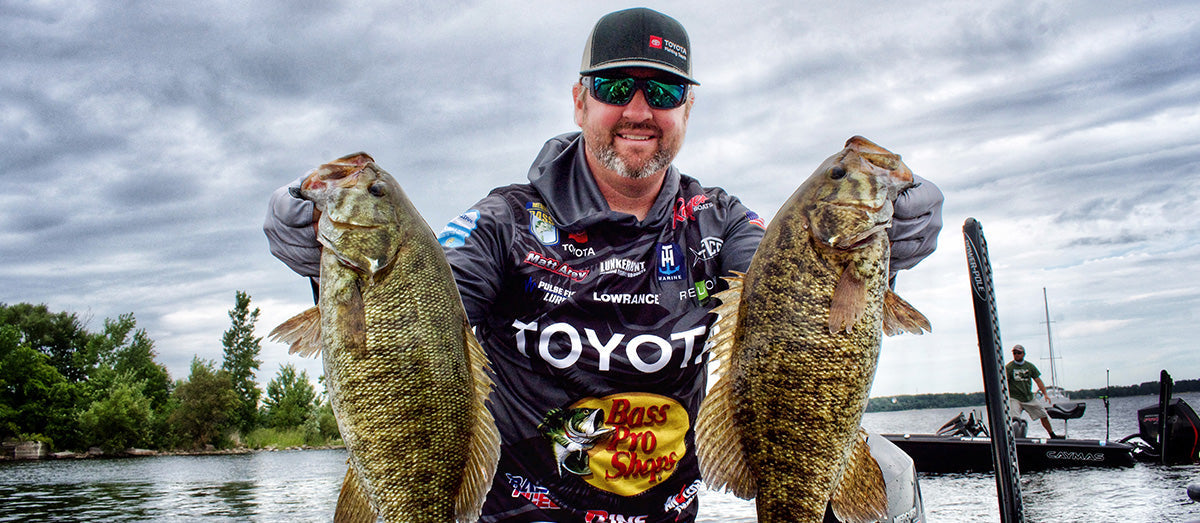
That single rule could dramatically change the way this field approaches Champlain. Instead of relying heavily on electronics to locate individual smallmouth, anglers will have to lean on more traditional techniques, visual clues, known areas and good old-fashioned instincts. According to Team Toyota pro Matt Arey, that could make this one of the more interesting tournaments of the season.
“There’s no forward-facing sonar for this tournament which changes the entire dynamic,” Arey said. “If it were allowed, it would be predominately smallmouth bass. But a lot of the field will test largemouth waters way more than they normally do.”
That creates an intriguing decision for every angler who launches their boat. Champlain has long been known for producing enormous bags of smallmouth and those fish are certainly not going anywhere. But without forward-facing sonar helping anglers efficiently identify individual fish and key pieces of structure, the traditional largemouth bite suddenly becomes much more attractive. The problem is that Champlain’s largemouth population isn't unlimited.
“There are select areas that produce largemouth on this fishery, but I don’t think they can handle all of that fishing pressure,” Arey said.
That pressure could become one of the defining storylines of the tournament. When a productive largemouth area gets discovered during practice, word travels quickly. Even if anglers aren't sharing information directly, the nature of a tournament field means productive water can receive an incredible amount of attention over four days. That makes the timing of an angler's decision especially important.
Do you commit to largemouth early and potentially get into an area before it receives too much pressure? Or do you build a dependable limit of smallmouth and then spend the remainder of the day hunting for a few bigger largemouth? Arey believes the latter strategy could make a lot of sense.
“If I were fishing this tournament, I’d go look for a starter bag of smallmouth,” he said. “Once I got up to about 15 pounds or more, I’d go look for a few key largemouth. But the potential issue is tricky. If you solely go after largemouth, you could really stump your toe due to the fishing pressure.”
That 15-pound benchmark could be an important number. Champlain's smallmouth can produce an extremely strong limit, particularly when anglers locate the right combination of grass, rock, current and depth. Once an angler has a solid limit secured, they can afford to gamble. There will be plenty of opportunities to do exactly that.
“I’m super excited to watch this tournament from a fan’s perspective,” Arey said. “There will be a lot of shallow largemouth and also smallmouth on the grass flats in six to 12 feet of water.”
That combination should create a fascinating contrast throughout the tournament. On one end of the spectrum, anglers will be targeting shallow largemouth with reaction baits and flipping presentations. On the other, they'll be searching grass flats and other offshore areas for smallmouth, relying on their understanding of Champlain's seasonal patterns rather than simply staring at a sonar screen.
The falling water level could add another wrinkle. As the water continues to come down, largemouth may become increasingly concentrated in certain areas. That can be a double-edged sword. Concentrated fish are easier to target but productive areas can also become magnets for fishing pressure. Arey expects anglers to pay especially close attention to marinas.
“The water level is coming down right now, so somebody could find a big, concentrated population of largemouth,” he said. “You need to keep an eye on all the marinas as well. Those will be hot targets.”
That should make the shallow game particularly interesting. When largemouth move around docks, marina structures, shoreline cover and other areas of available habitat, anglers can cover water quickly with power-fishing techniques. Bladed jigs can be deadly around vegetation and scattered cover, while flipping presentations allow anglers to slow down and thoroughly dissect the highest-percentage targets. Dock fishing could play a major role.
“It’s going to be an awesome tournament to watch,” Arey said. “You’ll see a lot of flipping, bladed jigs and dock fishing.”
Those techniques are nothing new on Lake Champlain, but their importance could be magnified without forward-facing sonar. Instead of hunting individual fish with electronics, anglers will have to make decisions based on water, cover, seasonal patterns and history. They'll have to manage productive areas, anticipate fishing pressure and decide when to leave fish that are biting to chase something potentially bigger. That could create exactly the kind of tournament that keeps fans guessing.
The smallmouth will undoubtedly provide a dependable foundation for many competitors. But somewhere along the way, somebody is likely to find a largemouth jackpot. The question is whether that angler can protect it long enough to make it count.
With falling water, shallow largemouth, grass-flat smallmouth and a field fishing without forward-facing sonar, Lake Champlain is set up to deliver a tournament where traditional instincts may be just as valuable as modern technology.