


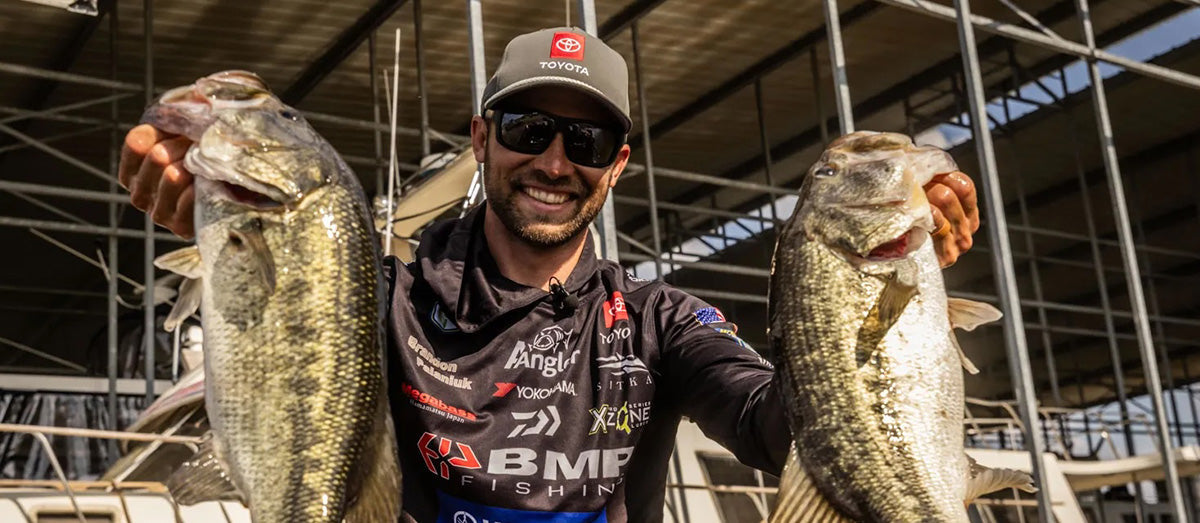
There’s a romance to river tournaments you just don’t find anywhere else in professional bass fishing. Current, color changes, backwaters and spawning pockets are all there, layered together in a way that rewards instinct just as much as execution. For Team Toyota pro Brandon Palaniuk, the recent Mountain Dew Bassmaster Elite at the Tennessee-Tombigbee Waterway was a welcome reminder of what makes this sport so addictive.

“I really enjoy the alternating format in regard to forward-facing sonar,” Palaniuk said. “It allows me to fish with two entirely different perspectives, and I love to learn as much as I can. For the Tombigbee, there was a real beauty in the simplicity, even on a very complex river system.”
That contrast is what defined the week.
The Tennessee-Tombigbee isn’t a place you can ever fully “solve.” It’s a system of locks, cuts, current seams and shallow backwaters that changes by the hour. Water levels fluctuate, fish reposition and what worked yesterday can burn you today.
Strip away some of the noise, however, and something interesting happens.
“If the technology were to be allowed here, there are so many other things that would go through your mind,” Palaniuk explained. “Should you be scoping deep holes? What about the deep timber? But this past week my approach was super simple and brought me back to my roots.”
That “roots” comment isn’t just lip service. Before the era of hyper-advanced electronics, success in tournaments like this came down to reading the moment and reacting accordingly. It’s less about chasing fish you can see on a screen and more about understanding fish you can’t. That understanding doesn’t always come easy.
“I find myself fishing more freely,” Palaniuk said. “I find myself running through the process of elimination even more than normal. For instance, on the first day of the tournament, I thought I had a gameplan and it didn’t work. Although I thought it was safe, my plan just kind of bombed. I had to scramble all day and only had about 9 1/2 pounds towards the end of the day.”
Anyone who has fished competitively knows that feeling. You spend time in practice building what you believe is a reliable pattern. You dial in locations, presentations and timing but when it matters most, it unravels. It happens to all of us. That’s where experience and maybe more importantly, intuition, steps in.
“That’s when my instinct and guts kicked in,” he said. “It was calm, hot and sunny so I got in a backwater to throw a frog and look for spawners. I figured even a two-pounder would be a good cull at that point. But the first bite I got was almost five pounds. 16-years of experience taught me how to make that adjustment on the fly. That fish had a fresh, bloody tail so I knew she was on a bed.”
It’s easy to gloss over moments like that but they’re everything. A less experienced angler might have committed to the original plan, hoping it would turn around. Palaniuk recognized the conditions and pivoted to something entirely different. That decision didn’t just salvage his day. It changed his entire tournament.
“I kept looking around and I barely could see a tail in the water in the same area,” he continued. “I made one pitch to it and she wouldn’t move. I slowly start dragging and shaking my bait, visualizing in my mind what was happening. Using intuition and experience. I felt the fish on my line for a second, but I could tell she didn’t bite yet. She spun on it.”
That level of awareness is hard to teach. It’s not just about what you feel but rather what you interpret. There’s a difference between a fish bumping a bait, inspecting it or fully committing. In shallow water, especially around spawning fish, those nuances matter.
“I stopped dragging and just started shaking it and right when I did that, she actually bit it,” Palaniuk said. “It was over five pounds, and I went from around nine pounds to over 16 pounds in a matter of minutes right before weigh-in.”
In tournament fishing, we often talk about momentum swings. That was one of them.
“I probably would have been in the 70s after the first day without that instinct and intuition,” he said. “But I ended up in fourth place after day one. That’s a huge difference in Angler of the Year points.”

Events like this magnify every decision. There’s no safety net. There’s no easy way to go find a school of fish you’ve been watching for days. You’re forced to adapt in real time and to trust what you know and commit to it fully.
That’s why anglers like Palaniuk thrive in these conditions. His style has always leaned toward versatility and decision-making rather than locking into a single technique. On a fishery like the Tombigbee, his mindset becomes a major advantage.
There’s a lesson there but it’s not just for pros. It’s easy to get caught up in doing things the “right” way, especially with so much information and technology available today. But sometimes, the best approach is the simplest one. Pay attention to the conditions, trust your instincts and make adjustments without hesitation.
“These kinds of events test your confidence to the core,” Palaniuk said. “And I absolutely love that.”
That love is what separates good anglers from great ones. Most can execute when things go according to plan, it’s what you do when they don’t that defines you. On the Tennessee-Tombigbee Waterway, Brandon Palaniuk didn’t just survive a tough tournament. He leaned into it, embraced the chaos, trusted his gut and let years of experience guide him through the kind of decision-making gauntlet for which river systems are known.